
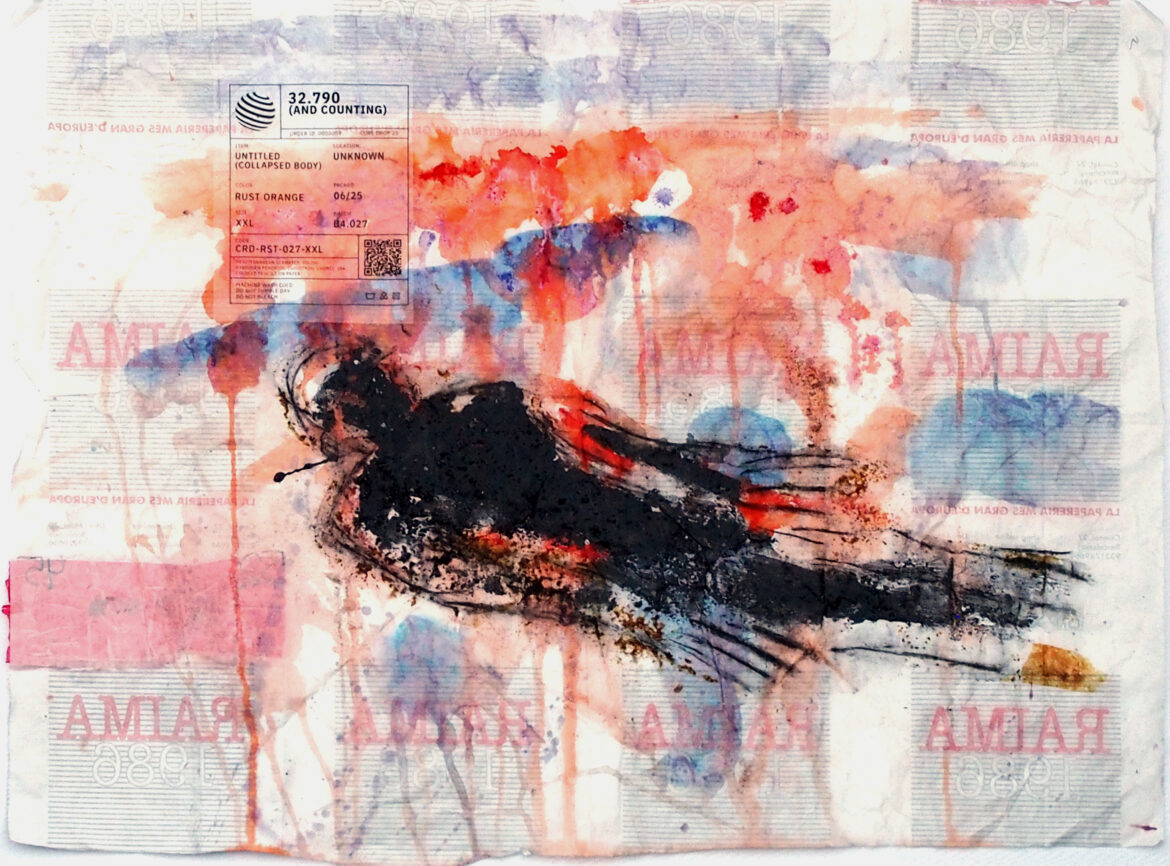
When I began 32,790 (and Counting) , I thought the number would function as a documentary point of departure. Soon afterward I understood that it was also the most unstable material in the entire project. While I prepared the works, consulted the sources, and made decisions about their form, the figure kept rising. The title had become obsolete before the series was finished.
That changed the way I understood the work. The number ceased to represent a totality and became the trace of a specific moment. It did not say how many people had died, but how many had been recorded when I began to look. Between that figure and the one the database returns today lies an interval occupied by new disappearances.
My first concern had been how to work with these deaths without turning them into another image of others’ suffering. Contemporary visual history is full of tragedies transformed into impeccable photographs, capable of moving us for a few seconds before disappearing beneath the next image. I did not want to add another aesthetic representation of catastrophe, nor to beautify a violence that has already been observed too many times from a comfortable distance.
Mediterranean water, antiseptics, charcoal, and materials associated with forensic practice appeared as a way of shifting the work from representation toward the indexical trace. I wanted the paper to take on something of an exposed body—a contaminated surface, a remainder, incomplete evidence. I did not intend to reconstruct a scene or to simulate a scientific document, but to work on what remains when identity, narrative, and, in many cases, the body itself have disappeared.
The QR code emerged when I understood that a static work could not contain a tragedy that keeps happening. Its function is not solely to provide information. It introduces a temporal fracture between the number fixed in the title and the living number of the system. When someone runs that query and discovers that the figure has changed, the distance between the two data points ceases to be abstract. That increase is made of people who died while the work already existed.
The logistics label came later and ended up revealing another contradiction. Our economic system can reconstruct with enormous precision the journey of a T-shirt, a phone, or a parcel from the warehouse to the door of a home. Each object has an identity, a route, and a verifiable destination. Yet a person can cross the Mediterranean, disappear, and be reduced to an estimate. This is not a technological incapacity, but a political hierarchy of what we consider worth tracking.
Incorporating a monetary value was the most uncomfortable decision. During the process I asked myself whether using the vocabulary of the Value of Statistical Life did not reproduce precisely what I wanted to question. The answer appeared when I observed that the obscenity did not begin in the work. It was already present in a system that assigns different values to lives of the same species according to their place of birth, their income, or the geography in which their death occurs.
The art market, too, is not outside that contradiction. To sell a work built around these disappearances means taking part in an economy capable of turning any conflict into an object. Allocating part of the proceeds to organizations working in the Mediterranean introduces a material consequence, but it neither resolves the dilemma nor offers moral absolution. I prefer that tension to remain visible, because to hide it would have been another form of comfort.
During this process I understood that I was not working solely with death, but with the way the territory takes part in its production, its concealment, and its meaning. From there emerged geothanatology as a framework for thinking a geography that does not act as a passive backdrop but as a political apparatus.
32,790 is not a monument to a figure. It is the record of the instant in which that figure began to escape the work. Each time the QR code returns a different number, the project returns to the present and forces us to look at the space that has opened between the two.
That space is full of people.