
Drift
Installation, 2026
Approved final work, International Master in Contemporary Photography, PhotoESPAÑA / EFTI
Status: pieces produced. Public presentation postponed; scheduled for 2027.
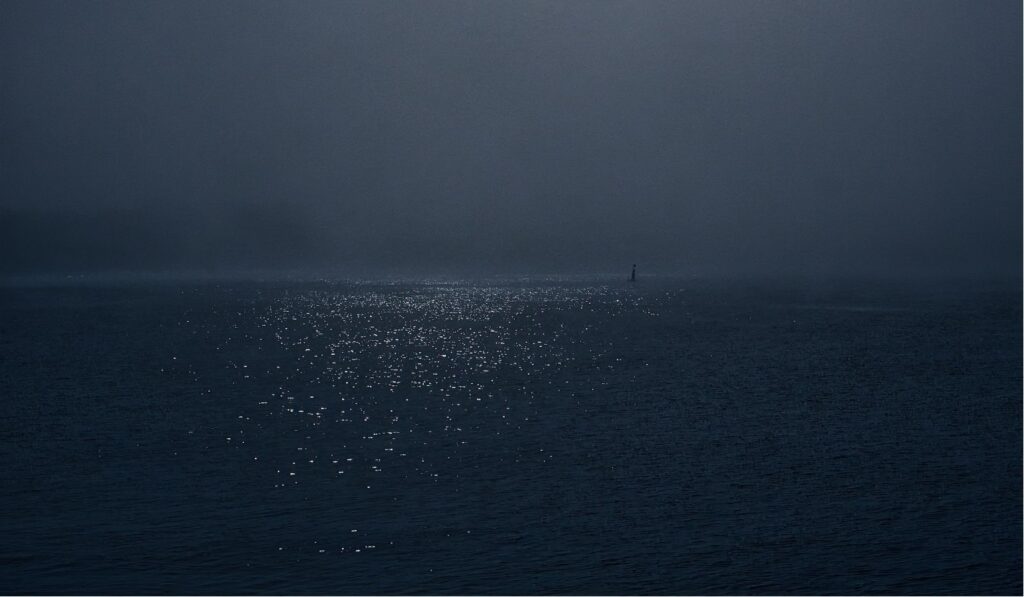
The Mediterranean is now a palimpsest of shipwrecks. A blue that does not look, but conceals. Beneath the static surface of the landscape, the horizon has become a veil wrapping the largest geography of oblivion of our time.
In the liquid abyss, the rusted steel of old wars waits to merge with the fragility of the organic. History turns into trace, and the body into matter worked on by silence. There are no shores, only a cartography where salt devours identity and flesh gives itself over to the indifference of a sea that no longer knows how to tell a wreck from a man. It is the trace of a Europe consuming itself in its own silence before a mass grave, adrift in the blue.
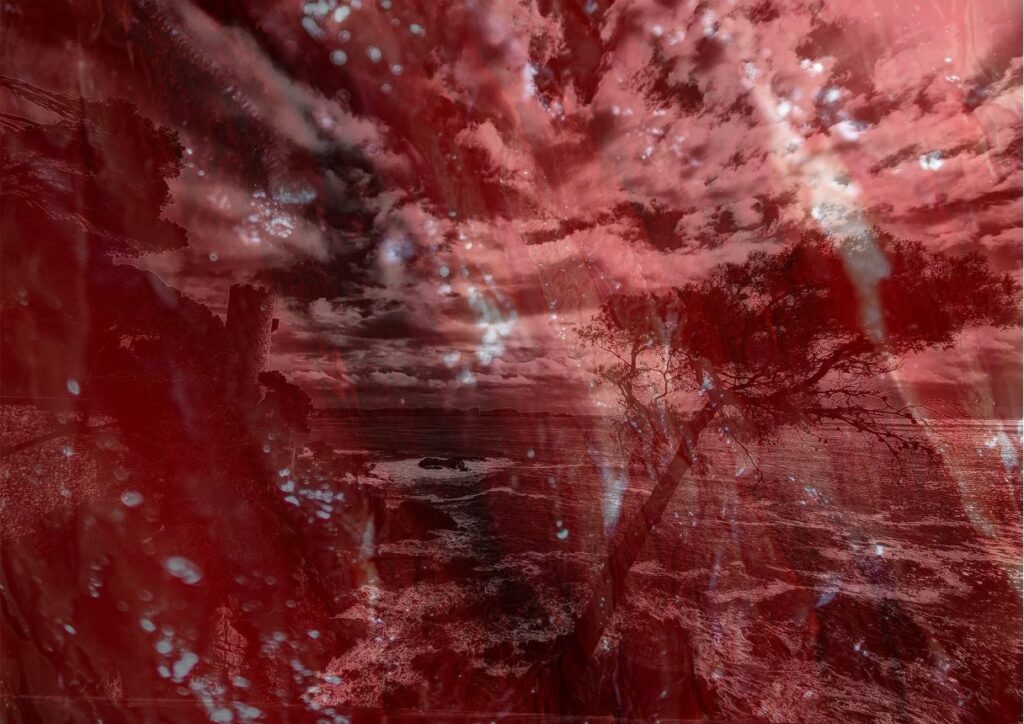
Drift is a personal gaze from the wound of an artist turned immigrant. It is one chapter of an investigation that began on the island of Cuba, in the waters of the Florida Straits, and has emptied into the Mediterranean. The pieces exist to ask how far we decide not to look at the death of others; how far we deny the misfortune of those who put to sea in search of a “better” world.
Drift sets no figure of its own. The count belongs to 32,790 and Counting, where the number in the title is the one the Missing Migrants Project recorded when that work began. The installation label will carry the same QR code as those pieces, linked to the live source. Whoever stops in front of the work will not read a closed number, but whatever the number is at that moment. The whole argument fits in the gap between what the title says and what the phone returns.
Drift is an installation approved as the final work of the International Master in Contemporary Photography and Project Management of PhotoESPAÑA and EFTI, in June 2026.
The installation is part of the artist’s larger investigation into the Mediterranean as a space of contemporary disappearance, in continuity with the project Golden Standard and with the curatorial program Gold Route.
Structure and materiality
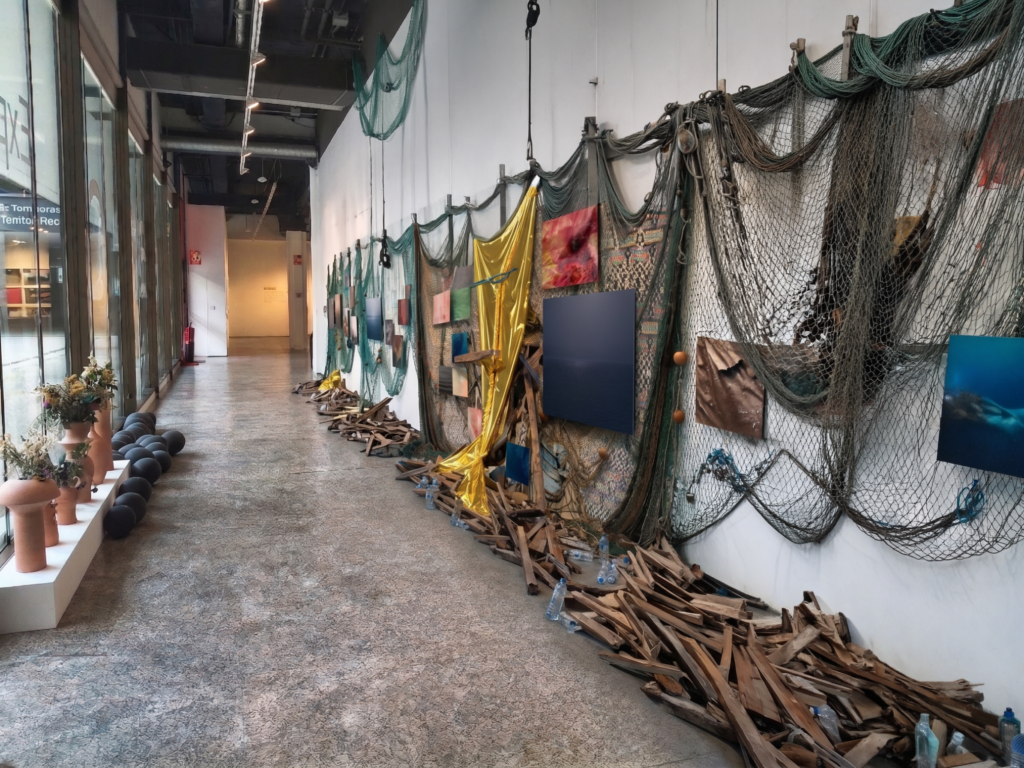
The installation is built around a central axis of material chaos. The viewer meets a pyramidal composition of splintered wood, remains that evoke the violent dismantling of a boat. That center of gravity is crossed by a golden thermal blanket falling vertically, acting as a wound of light: its industrial sheen set against the opacity of the debris and the fishing net that serves as backdrop.
On the horizontal plane, the floor is invaded by a scattering of empty water bottles, traces of an absent human presence that turn the pavement into a metaphorical shore after the disaster.
Found materials set against the sophistication of the photographic mounting produce a language of contemporary archaeology that documents an active crisis. Migration statistics become physical experience. This is a work that is not only looked at: it is suffered.
Anatomy and memory
The visual narrative unfolds across the fishing net through polyptychs alternating two rigid supports: methacrylate, which lends a glassy, aseptic depth, and dibond, which gives an industrial, technical flatness.
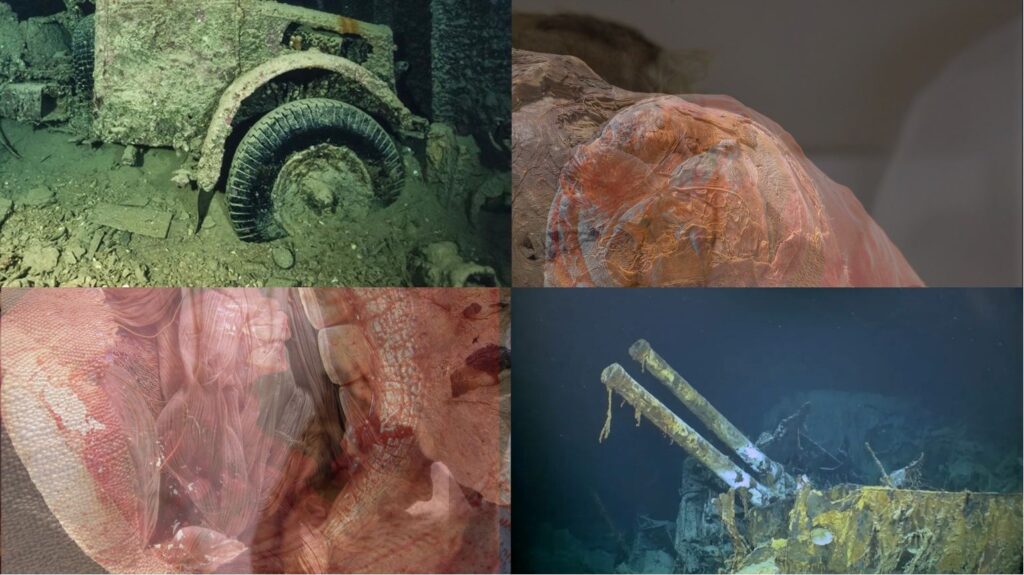
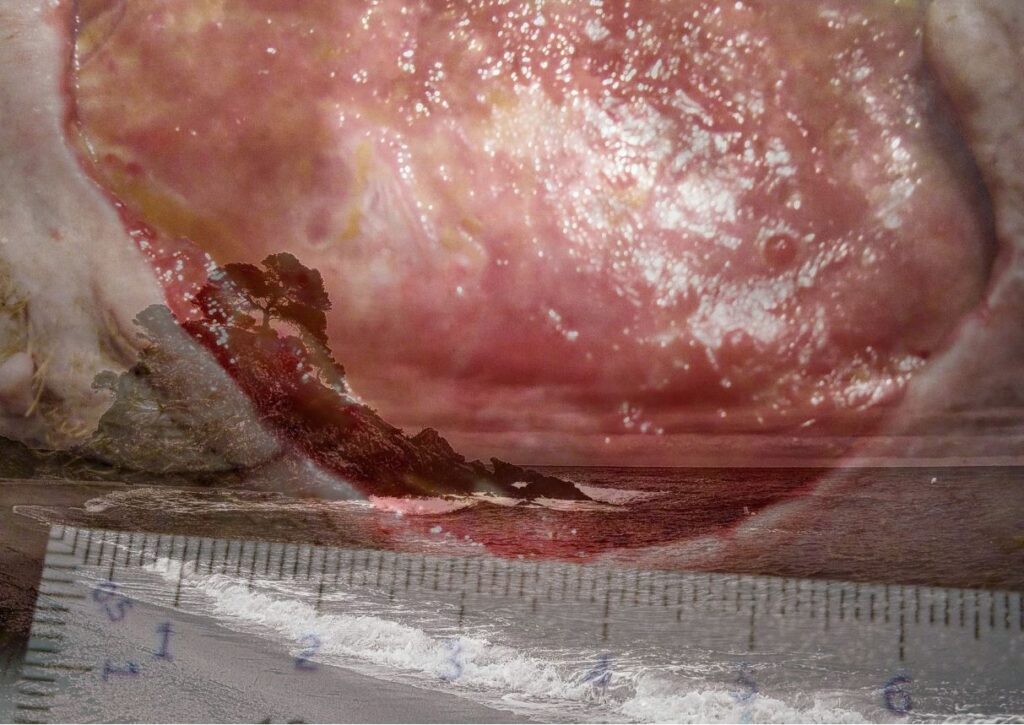
The abject and the forensic. The work incorporates images of pathological anatomy, forensic medicine and invasive surgery. These photographs of raw biological material strip the body of its identity to turn it into matter, a direct reference to the dehumanization of the victims in the Mediterranean.
Historical contrasts. Photographs of Second World War wrecks are interleaved. Placing those remains beside the net and the wood builds a bridge across time: the sea is not only an ecosystem, it is a stratified cemetery of human conflicts.
Liminal landscapes and double exposure. The compositions where the abject merges with transitional landscapes reinforce the sense of non-place. It is the visualization of interrupted transit.
Details
- Polyptych on aluminium dibond, 100 × 75 cm
- Matte fine art print on methacrylate, 30 × 40 cm (two pieces)
- Gloss fine art print on aluminium dibond, 60 × 45 cm
- Hahnemühle fine art print on aluminium dibond, 80 × 60 cm
- Matte fine art print on forex board, 70 × 50 cm
Fishing net, splintered wood, golden thermal blankets and water bottles. Dimensions variable according to the space. Label with a QR code linked to the live source of the count.
Status note
The images presented here are the digital visualization of the project within the real gallery space, composed with the artist’s own work and material photographed by the artist. The physical execution of the installation is anticipated within the framework of an open call or exhibition program. Digital composition produced with simulation and photo-editing tools.