
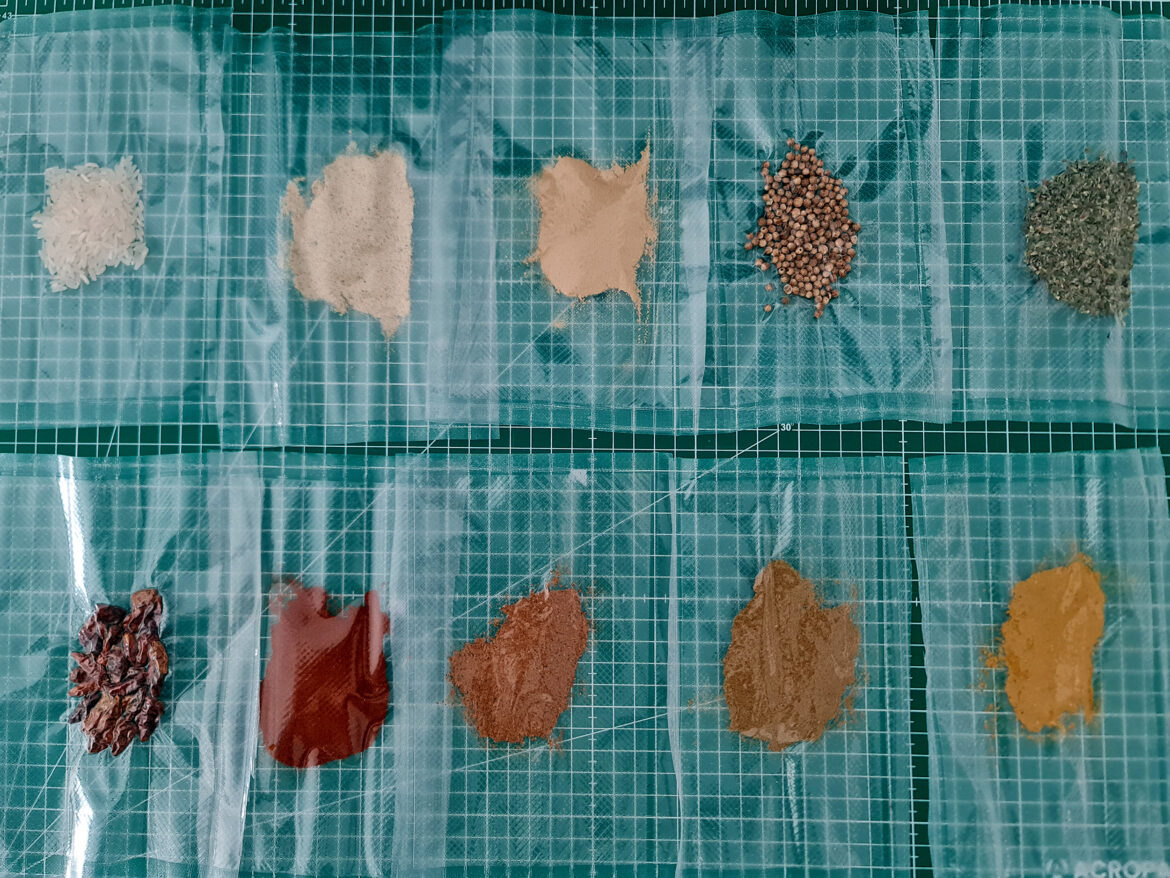
Lately, I have been trying to shift the way I approach displacement itself. For quite some time, part of my work has addressed migration, disappearance and death through territory, archives, statistics, and found or transformed materials. Without abandoning these tools, I have begun to ask what happens when we stop looking exclusively at the place where someone disappears and start paying attention to what a person manages to carry with them, even when they appear to be carrying nothing at all.
Territory can also travel within the body. A smell, a taste, a learned recipe, or the almost unconscious proportion between two ingredients can survive a border, travel thousands of kilometres and persist across several generations. I am interested in this domestic memory because it offers another way of approaching displacement, not necessarily through its direct representation, but through the seemingly insignificant traces that persist after a territory has been left behind. This exploration is also leading me to reconsider the processes through which I construct images, because cooking, heating, impregnating, eroding, preserving, wrapping, or working with the residues left by these processes can themselves become artistic operations. Matter then ceases to illustrate the phenomenon and begins to participate in its conceptual construction.
This is not unexplored territory. Rirkrit Tiravanija turned the preparation and sharing of food into a social and political space, while Michael Rakowitz has worked with recipes, displacement, family memory and political history through his relationship with the Iraqi diaspora. From a different position, Mona Hatoum has transformed objects associated with home and everyday life into devices permeated by exile, vulnerability and violence, while Doris Salcedo has demonstrated the extent to which an ordinary object can embody absence without having to represent the missing body. I am interested in these shifts because they allow the political question to move temporarily away from the image of the event itself and emerge instead through its remnants, objects, gestures and consequences.
In these new experiments, I am working with extremely elementary materials such as flour, yeast, fats, spices, residues, industrial surfaces, heat and plastic. They are domestic materials that, when subjected to certain processes, gradually lose their original function and acquire another condition. I am not interested in representing a migrant boat, a border or a body simply because I am speaking about migration, just as I do not believe that precarity, disappearance or death must always be turned into images in order to become present.
I am searching for what might remain when explicit representation is removed and attention is given to other forms of persistence. Displacement does not simply mean moving from one territory to another. It also involves remembering, reconstructing, adapting or replacing what has been left behind, and discovering that certain places can continue to exist long after we have departed from them. Sometimes, an entire territory can persist in something as small and apparently ordinary as a taste.