
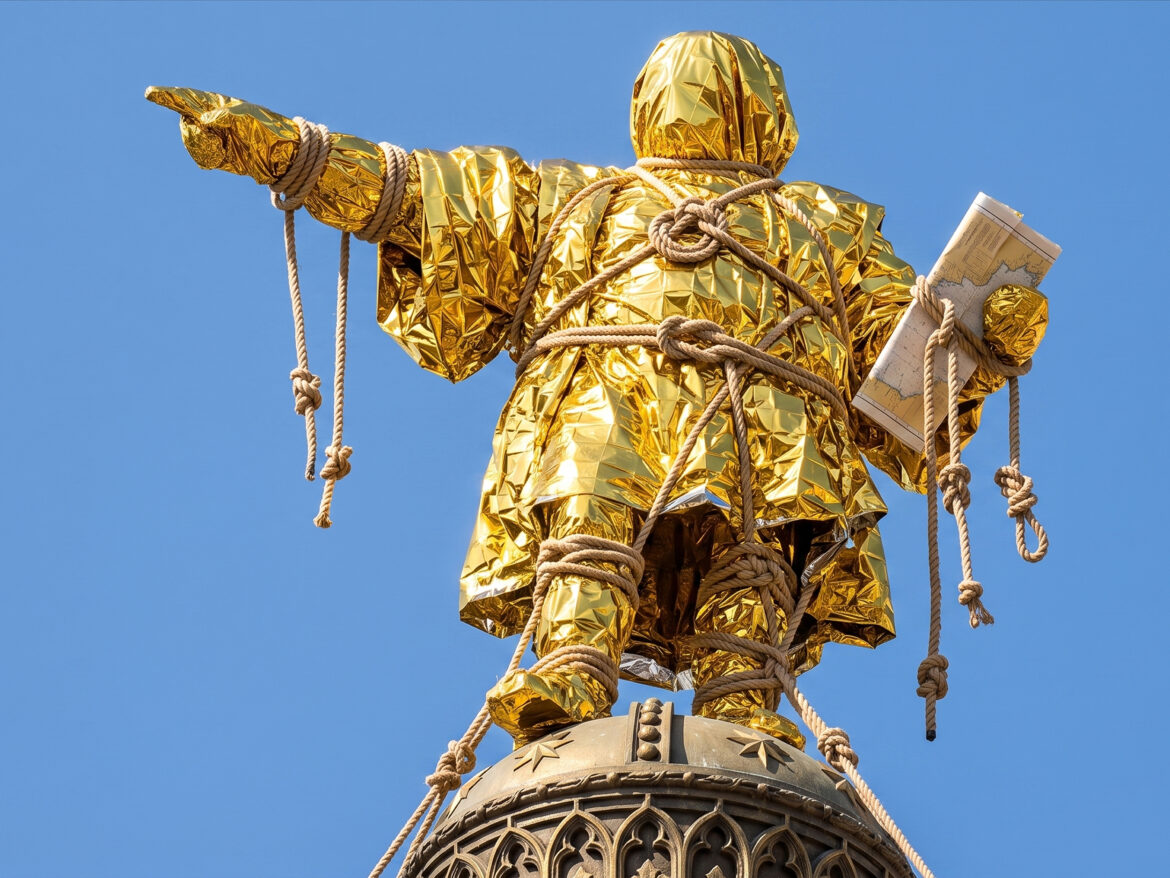
The Gold Route is not solely a project about decolonization. It is also an intervention in public space, in the symbolic authority of monuments, and in a city’s capacity to reconsider what it has chosen to immortalize. A monument is not a passive piece of bronze or stone. It is a form of political narration embedded in the everyday landscape, a story that, through sheer permanence, eventually begins to appear natural. Temporarily intervening in it does not mean destroying it or denying its existence. It means interrupting, for a few days, the apparent stability of its narrative. Sometimes an image must be covered before we can begin to see everything that image has concealed.
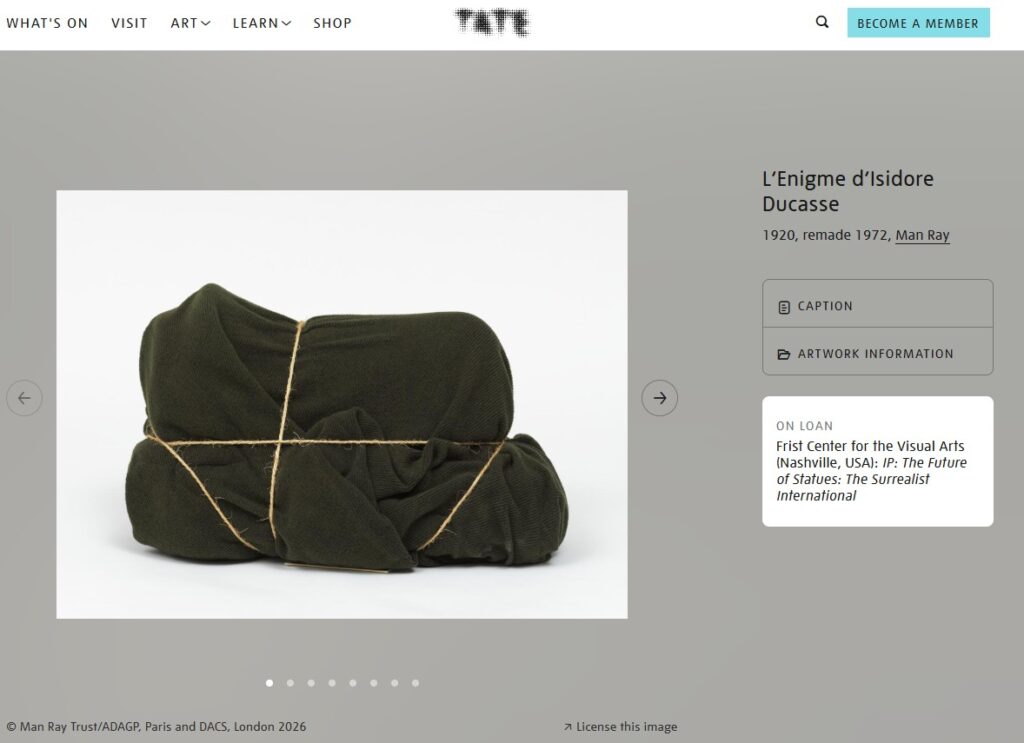
The act of wrapping objects and monuments belongs to a well-established artistic genealogy. In 1920, Man Ray created The Enigma of Isidore Ducasse by wrapping a sewing machine in a military blanket and tying it with string. By concealing an ordinary, recognizable, and functional object, he turned it into an uncertain presence. The machine ceased to be a machine and became a mental possibility. The viewer could no longer verify what stood before them and had to rely on imagination, desire, mystery, and the subconscious. Man Ray understood very early that wrapping does not simply hide an object. It can also release that object from its habitual identity.
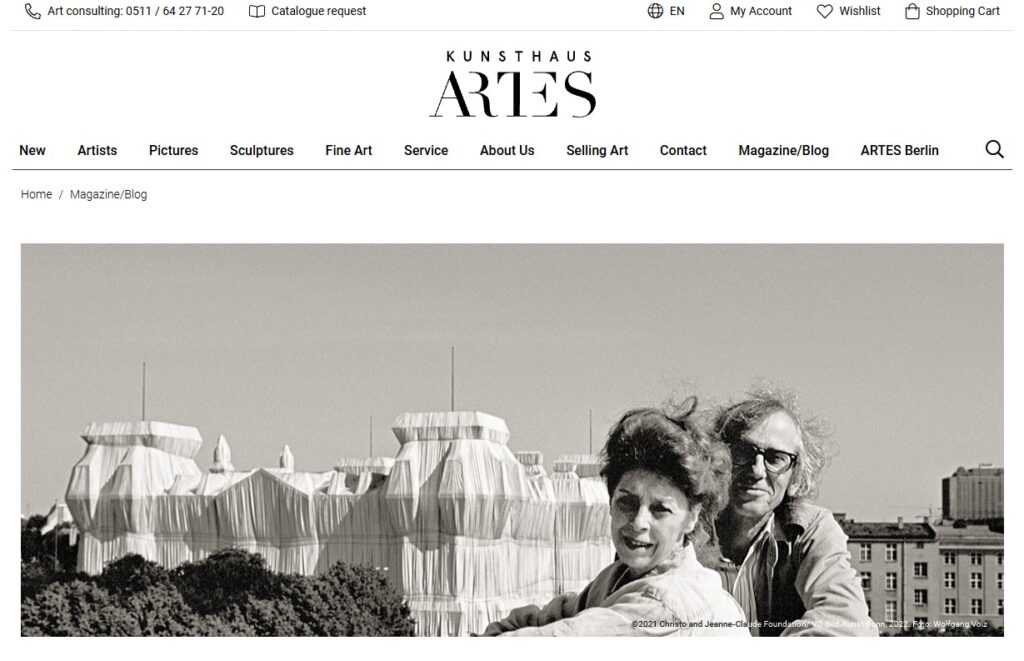
Decades later, Christo and Jeanne-Claude expanded this operation to the scale of architecture, landscape, and institutional politics. Wrapped Reichstag, completed in Berlin in 1995, required twenty-four years of conversations, refusals, negotiations, and persistence before it was authorized. The intervention remained in place for only two weeks. It was temporary, fully reversible, and financed by the artists through the sale of studies, drawings, collages, and other preparatory works. The waiting, administrative procedures, and parliamentary debate were not external to the artwork. They became part of it. The Reichstag was not only wrapped in fabric. It first had to pass through a dense political wrapping of its own.
At the opposite end of this institutional patience stands Olek, the working name of Agata Oleksiak. In December 2010, Olek covered Wall Street’s famous Charging Bull overnight with a multicolored crocheted skin. No permission was requested. The intervention lasted approximately two hours before it was removed. The choice of the bull was not innocent either. Arturo Di Modica’s sculpture had itself been installed without authorization as a guerrilla action after the 1987 stock market crash. Olek therefore wrapped an artwork born through an illegal intervention with another unauthorized intervention. Crochet, historically associated with domestic labor, women’s work, and care, occupied one of the most aggressive symbols of global finance for a few hours. Christo and Jeanne-Claude waited twenty-four years. Olek acted in a single night. Parliamentary debate was replaced by speed, surprise, and the street.

The tension between these two approaches is particularly important to me. One treats institutional negotiation as a constitutive part of the artwork. The other argues that the urgency of the gesture justifies the immediate occupation of public space. I do not believe that either approach is necessarily more authentic or more radical. Each reveals something different about power. Christo and Jeanne-Claude demonstrated how long an institution may take to allow a symbol to be transformed. Olek demonstrated how much an artwork can say before an institution has time to prevent it.
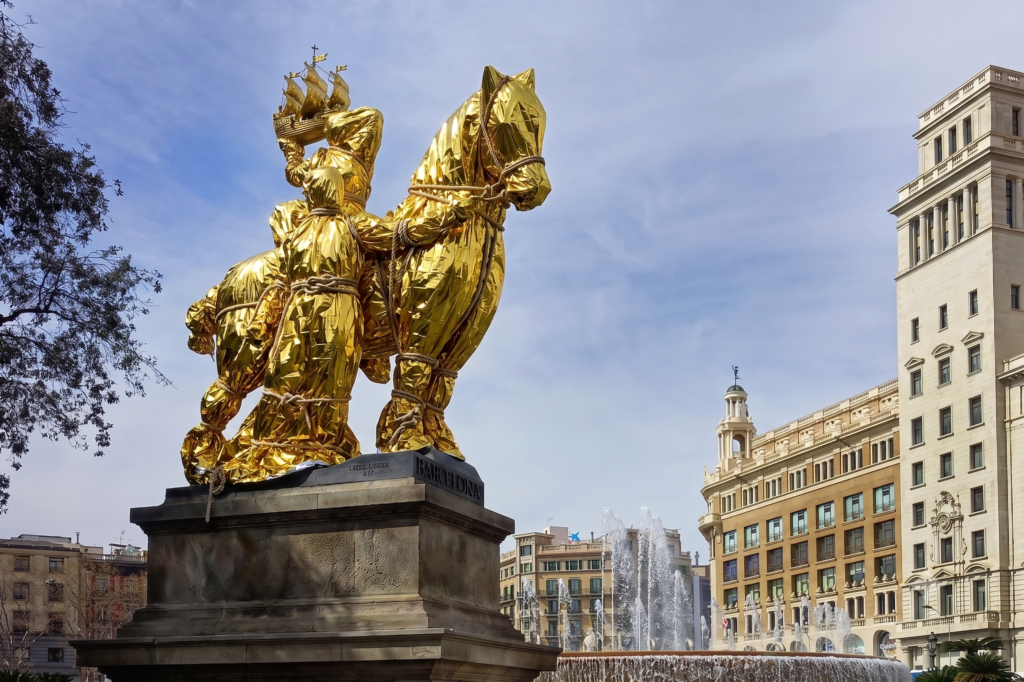
The Gold Route belongs to this genealogy, but it does not intend to repeat it. In my proposal, the gold thermal blanket is neither an ornamental surface nor a visually neutral fabric. It is an emergency material with a specific function already inscribed in it. It was designed to preserve the body heat of people who are exposed, injured, exhausted, or rescued from the sea. At the same time, its gold surface activates another memory. It evokes colonial gold, extraction, trade, accumulated wealth, and the maritime routes that connected imperial expansion with capital. The same material can speak of wealth and survival, conquest and vulnerability, what Europe extracted, and the bodies that now arrive at its borders.
The ropes and maritime knots reinforce this relationship. The project does not simply wrap a monument. It symbolically reconnects that monument to the sea and to the historical and contemporary routes that pass through Barcelona. The monument remains protected, the intervention is reversible, and no material trace is left on its surface. Its meaning, however, can no longer remain intact. For a brief period, the bronze hero appears wrapped in the same material given to someone who has survived a sea crossing. Gold no longer represents only power, glory, and abundance. It also represents cold, borders, waiting, and rescue.
My relationship with this subject does not come from distant observation. I do not approach migration as a cultural voyeur or as someone who discovers a convenient image in another person’s suffering. For nearly three years, I lived in Spain without legal status. I experienced administrative uncertainty, the fragility of not knowing what would happen the next day, and the sensation of physically existing in a country without yet occupying a recognized place within it. I can also say, with gratitude and without naivety, that Spain welcomed me, that I was eventually able to regularize my status, and that I managed to settle here and rebuild a life.
That experience does not give me the right to speak for every migrant, nor does it turn my biography into a form of moral authorization. It does prevent me from treating migration as an aesthetic abstraction or as a tragedy observed from a comfortable distance. The Gold Route emerges from that proximity, but also from a sense of critical responsibility. It does not attempt to illustrate migration or turn its victims into spectacle. It redirects attention toward the symbols of power that organize public space and asks what happens when a material associated with the vulnerable body temporarily covers the monumental body.
In September, I will formally submit the proposal to the Barcelona City Council. Requesting permission is not an act of submission. It is a decision consistent with the public nature of the work. I want an institutional conversation to take place, conservation requirements to be respected, and the city to have an opportunity to participate consciously in the debate. The response, however, will also become part of the project. Authorization would show that Barcelona can subject its own symbols to critical interpretation without believing that it has lost them. A refusal would raise another question. Is the institution protecting material heritage, or is it protecting the political comfort of leaving its story undisturbed?
Will the Barcelona City Council agree to let its monuments be temporarily covered with a material associated with migrant rescue? Will its representatives be able to set partisan differences aside and open a space for reflection on migration, colonial memory, and the Mediterranean? Can a city reconsider its symbols without turning every artistic gesture into an identity battle? Will it take me twenty-four years to obtain permission? Will I need to learn the patience of Christo and Jeanne-Claude? Or will I eventually have to resort to guerrilla action for the work to exist?