
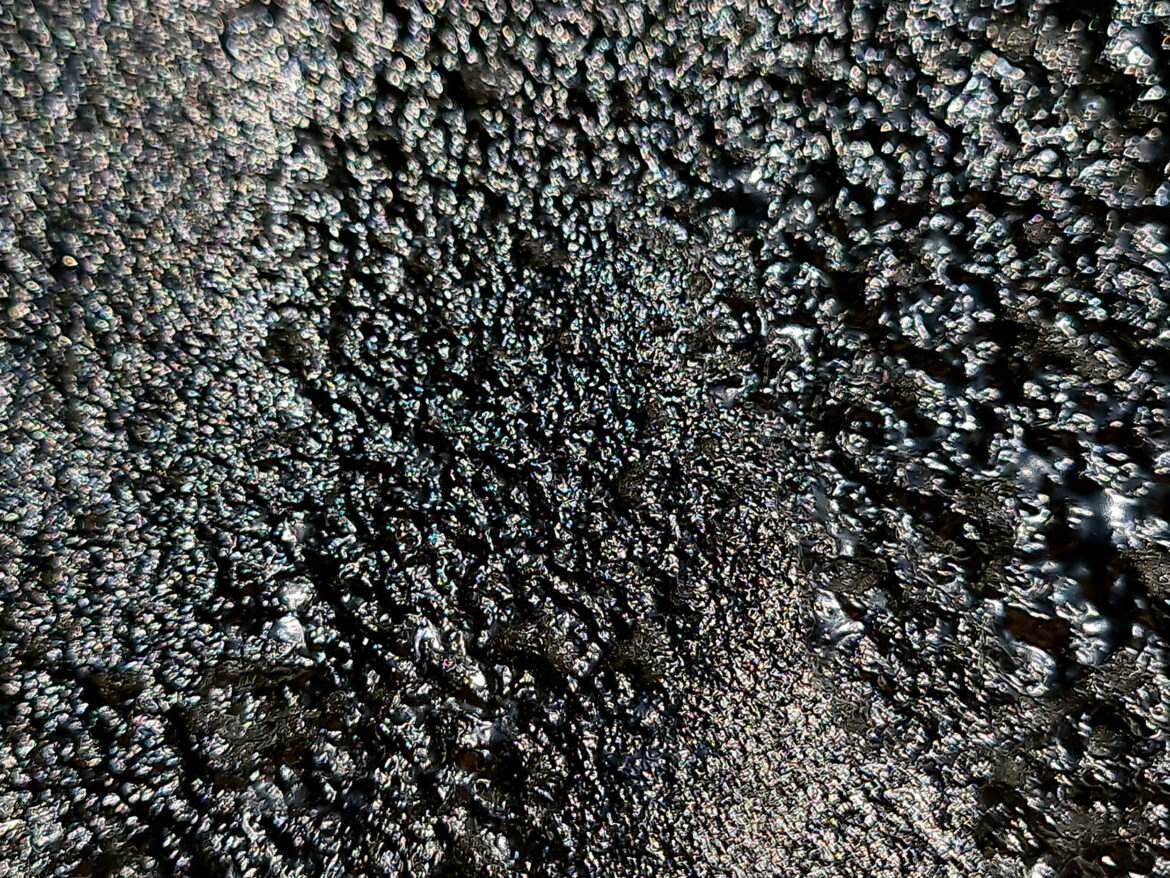
Drift was my final project for the PhotoESPAÑA International Master in Photography in 2026. From the outset, however, I was clear that I could not resolve it through a series of images aligned on a wall. The subject overflowed photography understood as an autonomous surface and demanded the construction of an apparatus in which images, materials, data, and space acted together.
It was not a matter of adding objects around the photographs to create a stage set. The installation was the work. The fishing net, the splintered wood, the empty bottles, the thermal blanket, the scattered remains, and the different photographic supports composed a system of relations. Each element contributed a distinct form of knowledge and obliged the viewer to move between registers that could not be reduced to a single image.
This way of working is part of an extensive genealogy. From the late 1960s, photography began to abandon the frame and to relate to sculpture, architecture, text, the archive, and the exhibition space. The exhibition Photography into Sculpture, held at MoMA in 1970, brought together practices that already questioned photography as a flat, self-sufficient object. The image ceased to be merely a window and became matter, volume, and situation.
I also find a fundamental reference in The Bowery in Two Inadequate Descriptive Systems by Martha Rosler. In that work, the photographs and the words made evident the inadequacy of documentary systems to describe a social reality without reducing it or visually exploiting those who endure it. That distrust of the image that claims to explain everything remains decisive for me. In the face of suffering, to show more does not necessarily mean to understand better.
The relationship between photography, text, research, and maritime economy also runs through Fish Story by Allan Sekula. His work turned ports, vessels, and ocean routes into a critical reading of globalization. Sekula understood that the sea was not a natural space separate from history, but a political and industrial infrastructure. His photographs, textual panels, and projections built a narrative that no isolated image could have contained.
Christian Boltanski shifted photography toward the archive, the memorial, and the installation through anonymous found images that were rephotographed. His work on loss, death, and memory demonstrated that a photograph can function less as the portrait of an identity than as the sign of an absence. In his installations, accumulation, lighting, and space alter the status of the image and turn it into a question about who is remembered and who disappears from the collective narrative. The Guggenheim describes this documentary and memorial dimension of his work.
The forensic materiality of Teresa Margolles constitutes another essential precedent. In her practice, the traces and substances linked to violence do not represent the body, but rather introduce its absence into the exhibition space. Matter ceases to be a plastic resource and becomes testimony. Her work examines the social consequences of death through installations that physically implicate the viewer. This transformation of residue into political presence interests me especially because it prevents violence from remaining confined within an image contemplated from a safe distance.
To this artistic genealogy is added the research developed by Forensic Architecture and Forensic Oceanography. Their projects bring together satellite images, communications, testimonies, spatial models, and navigation data to reconstruct events that States deny or present as accidents. In Liquid Traces, the trajectory of a boat abandoned in the Mediterranean turns the movement of the sea into political evidence. The ocean ceases to be a backdrop and begins to testify.
My work situates itself at the confluence of these traditions, though it does not seek to imitate them or to claim the authority of a professional forensic investigation. I use their codes to interrogate what we consider evidence, how a memory is constructed when there is no body, and in what way an image can resist the conversion of suffering into spectacle.
In Drift, the images of pathological anatomy, the wrecks of old wars, and the maritime landscapes do not establish a linear narration. They function through friction. The body approaches the landscape, the historical residue mixes with the present, and the blue ceases to be a contemplative surface. The polyptychs on dibond, methacrylate, and paper introduce industrial, aseptic, transparent, or fragile qualities that modify the meaning of each image. The support does not contain the message. It also produces it.
The thermal blanket concentrates a similar contradiction. Its gold seduces, reflects the light, and occupies the visual center of the installation, yet it refers to survival, emergency, and the vulnerability of the rescued body. The net can hold, capture, or abandon. The wood evokes a destroyed vessel without reconstructing any one in particular. The empty bottles function as traces of a presence that is no longer there. None of these objects literally illustrates a death, but all take part in the construction of its absence.
The data introduces another regime of visibility. Statistics provide scale, continuity, and contrast, but they also lay bare the way in which thousands of lives end up condensed into a figure. When the number confronts matter, the anatomical images, and the scattered remains, it ceases to function as neutral information. The installation tries to keep open the tension between the quantifiable and that which no figure can contain.
That is why I work through apparatuses. There are realities that a photograph can record but not necessarily articulate. I need the image to dialogue with the object, the data to contradict the landscape, and the materiality to force the viewer’s body to occupy a position. The work does not seek to offer a total representation or to resolve what it shows. It tries to build the conditions for something that usually remains hidden to become perceptible again.
I do not want to use photography to assert that a tragedy occurred. I want the entire apparatus to force us to ask why it continues to occur while we learn, once again, not to see it.